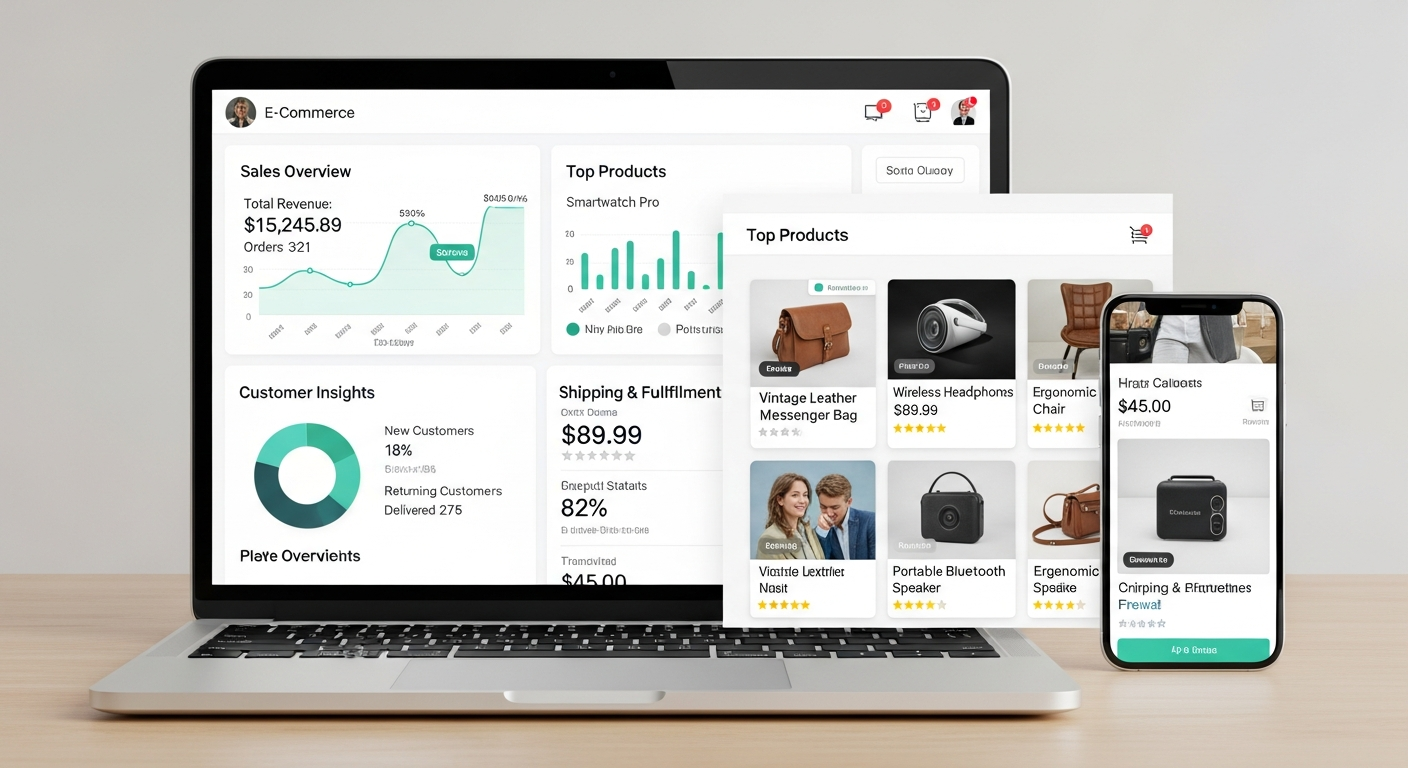
best ecommerce web design companies
Why ecommerce stores win with professional design: faster SEO gains, higher conversions, and stronger buyer trust.
Selling online in 2025 is more competitive than ever. A store that looks good isn't enough — it needs speed, search visibility, persuasive product pages, and a checkout customers trust. Professional ecommerce design combines UX, SEO and conversion optimisation to turn visitors into repeat buyers.
Why professional ecommerce web design matters in 2025
An ecommerce store is both a marketing channel and a sales tool. Professional design aligns the store with search engines, shoppers' expectations, and business goals — not just aesthetics. The result: more traffic, higher conversion rates, fewer abandoned carts, and customers who come back.
Search-first product pages
Optimised titles, descriptions, structured data and fast load times — product pages built for search drive organic acquisition without ongoing ad spend.
Conversion-focused UX
Clear product hierarchy, persuasive copy, urgency cues, and simplified checkout paths reduce friction and lift conversion rates.
Trust and compliance
SSL, PCI-compliant payments, clear returns and policies — these signals increase buyer confidence and reduce refund/dispute rates.
SEO benefits only professional design reliably delivers
SEO for ecommerce is technical and ongoing. A good agency builds foundations that let your product pages rank and scale.
Technical SEO & performance
- Image optimisation (responsive srcset, lazy-loading)
- Fast TTFB and CDN hosting tailored for catalog scale
- Mobile-first design with sub-2s target for Core Web Vitals
- Proper canonicalisation for pagination, variants and faceted navigation
On-page & structured data
- Product schema (price, availability, reviews) for rich snippets
- Optimised headings and semantic HTML for category and product pages
- XML sitemaps, hreflang (if international), and robots rules done right
- Content strategy that targets buying-intent keywords (not just traffic)
Pro tip: technical SEO mistakes (indexing product variants or paginated pages) can waste months of effort. A professional build prevents costly SEO regressions.
Customer acquisition & conversion optimisation
Professional design focuses on the funnel: how visitors find a product, decide, and complete checkout. Small UX improvements compound into big revenue gains.
Higher Add-to-Cart rates
Optimised product imagery, zoom, and bullet-point features increase shopper confidence and the add-to-cart metric.
Lower cart abandonment
Clear shipping info, guest checkout, one-click payments (Apple Pay/Google Pay) and progress indicators reduce abandonment.
Higher repeat purchase rate
Post-purchase flows, easy account access, and loyalty prompts turn first-time buyers into repeat customers.
Simple CRO experiments to prioritize
- Test variations of product page layouts (images vs gallery vs video)
- AB test CTA copy & colour on product and cart pages
- Remove distractions on checkout (one-step checkout)
- Experiment with free shipping thresholds and urgency messaging
Online credibility: what professional design builds for you
Trust signals reduce buyer hesitation. Professional agencies implement them consistently across thousands of pages.
Security & compliance
HTTPS everywhere, secure payment integrations, cookie/privacy banners that comply with local laws, and proper refund/returns pages.
Social proof & product info
Optimised placement of product reviews, clear stock status, accurate shipping estimates and photo/video verification all boost trust and conversions.
Platform choices: Shopify, WooCommerce, BigCommerce and headless
The right platform depends on catalog size, customisation needs, integrations, and budget. Professional agencies help you choose and implement the best fit.
Shopify
Fast to launch, excellent checkout, large app ecosystem. Ideal for small to mid-size stores that prioritise reliability and speed.
WooCommerce (WordPress)
Highly customisable and SEO-friendly for content-driven shops. Requires managed hosting and more technical maintenance.
BigCommerce & Headless
Scales well for larger catalogs and omnichannel operations. Headless architectures deliver extreme performance but need developer resources.
Agencies that specialise in ecommerce will map your integrations (ERP, inventory, shipping, reviews, payments) into the build — avoiding future migration headaches.
Cost vs ROI: why a professional build pays for itself
A small lift in conversion rate or average order value (AOV) can create large revenue increases. Here are simple examples.
Example: Conversion lift
Current monthly traffic: 10,000 visitors. Conversion rate: 1.5%. AOV: $80.
- Current monthly orders = 150 → Revenue = $12,000
- If design lifts conversion to 2.1% (+40%), orders = 210 → Revenue = $16,800
- Revenue uplift = $4,800/mo → $57,600/yr
Example: Reduce cart abandonment
Cart abandonment reduced from 75% to 60% via checkout simplification and payment options.
- Monthly carts started: 500 → Completed orders at 25% = 125
- After optimisation: completion rate 40% → 200 orders
- At $80 AOV, uplift = 75 orders = $6,000/mo → $72,000/yr
Even modest improvements easily justify a professional design fee. The key is predictable pricing and measurable experiments.
How a professional ecommerce web design process works
A reliable process reduces risk and gets your store selling quickly.
Discovery
Goals, audience, integrations and KPI targets.
Design & Prototype
High-fidelity product and checkout mockups for quick sign-off.
Build & Integrate
Fast, SEO-friendly build with analytics and payment setup.
Launch & Iterate
Track results, run CRO tests, and iterate to scale revenue.
Frequently asked questions
How long does a professional ecommerce build take?
Which platform ranks better for SEO: Shopify or WooCommerce?
Will a redesign hurt my current SEO?
What ongoing services should I expect after launch?
Ready to grow your ecommerce revenue?
Get a professional, SEO-first ecommerce store built for conversions, speed and trust. Start with a clear plan and measurable goals — then watch the revenue follow.
No lock-in contracts. Professional support, hosting and security included with most agency plans.
